


Carnegie Mellon University in Qatar (CMU-Q) hosted the inaugural GCC Information Systems Symposium in Education City. This landmark symposium is the first event of its kind, gathering IS educators and scholars from across the Gulf region. CMU-Q is a Qatar Foundation partner university.
Michael Trick, Dean of Carnegie Mellon University in Qatar, noted the timeliness of the symposium: "As artificial intelligence tools become more prevalent, it is essential for educators in the region to discuss the challenges and opportunities of the road ahead. We are educating future leaders, industry professionals and researchers, and together we can foster regional collaboration and guide the conversation about the critical role of Information Systems in the GCC."
The one-day event brought together 70 participants, including scholars from each of the GCC countries, as well as Morocco, Turkiye and the United Kingdom. Following the event, there was a strong desire expressed by participants to continue the tradition and formalize an Information Systems community across the GCC.
The strategic role of IS in an AI-driven world
The global pivot toward AI is demanding strategic, ethical, systems-level expertise. IS professionals are the critical link between powerful AI capabilities and human impact, and graduates must have deep knowledge of data management, security, governance, and effective integration of these technologies into society.
Nui Vatanasakdakul, Teaching Professor of Information Systems at CMU-Q, initiated this regional collaboration and served as chair of the symposium:
“It is imperative that we come together as experts across the region to define the future of Information Systems. This symposium is a crucial platform where we transform local insights and academic research into actionable, collaborative strategies that will drive and accelerate the GCC’s digital and AI transformation.”
The organizing committee included distinguished academics from across the Gulf Cooperation Council region: Salman Aljazzaf from Kuwait University, Kuwait; Jumanah Alshehri from Imam Abdulrahman Bin Faisal University, Saudi Arabia; Eman Alyami from Saudi Electronic University, Saudi Arabia; Mona Alyami from Taif University, Saudi Arabia; Xin Huang from CMU-Q, Qatar; and Mazen Shawosh from King Fahd University of Petroleum and Minerals, Saudi Arabia.
Centerpiece discussion: How IS contributes to AI transformation
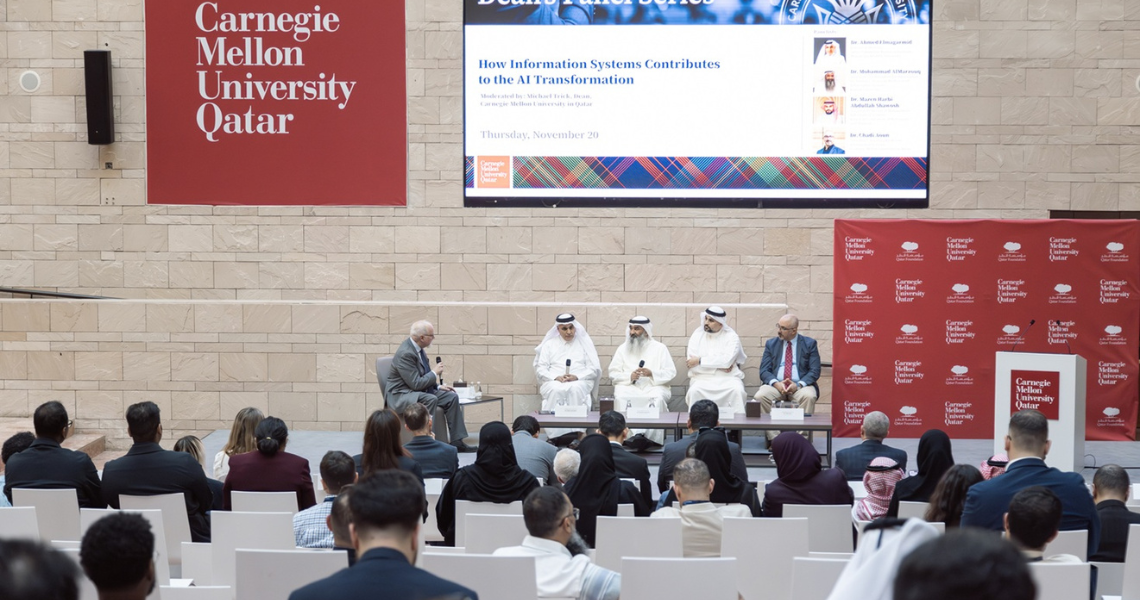
A centerpiece of the symposium was a Dean’s Panel Series discussion moderated by Michael Trick. The conversation delved into how IS scholars, researchers, and industry professionals can ensure that AI is delivering measurable, ethical value.
The panel convened important perspectives in IS research and education from across the Gulf:
Ahmed Elmagarmid, Executive Director of the Qatar Computing Research Institute, is a distinguished leader who has served on national and international committees shaping research, innovation, and AI adoption in healthcare, genomics, infrastructure, and public policy.
“As organizations and educational institutions adopt AI, they often discover that their data, processes, and systems require further preparation to fully understand their needs. By using structured indicators organized across clearly defined pillars, IS professionals can systematically assess organizational readiness. This approach ensures that AI is implemented effectively and aligned with actual operational requirements.”
Mohammad Almarzouq, Assistant Vice President for Information Technology, Kuwait University, is an expert in public sector innovation, e-government, and large-scale project management within the Arab world.
“In the public sector, adopting AI requires more than just understanding the technology. It also means understanding how the government works. With regulations, established processes, and strict accountability, public institutions have unique needs. IS professionals help by designing AI solutions that fit these requirements and by guiding organizations through a smooth and responsible adoption process.”
Mazen Harbi Abdullah Shawosh, Assistant Professor of Management Information Systems at Saudi Arabia’s King Fahd University of Petroleum and Minerals, provided crucial insight into data governance, organizational privacy, and the strategic leadership required for successful digital transformation.
“Information Systems bring together the social and technical dimensions of innovation. AI interacts with organizational structures, processes, policies, and the ways people work. IS experts study these elements together, providing insights into privacy, governance, and system design. This socio technical perspective helps ensure that AI solutions function effectively within real organizational environments.”
Chadi Aoun, CMU-Q’s Area Head of Information Systems, brought a focus on the ethical and regulatory dimensions of AI, as well as education, ensuring that technological adoption aligns with sustainability and societal benefit.
“IS professionals play a critical role by aligning organizational goals, socio-cultural factors, and technological needs, contributing to effective, measurable, and responsible AI outcomes. Developing core capabilities in our region - both human and technological - is therefore essential for us to attain human centered, ethical, and culturally oriented AI systems. IS education is therefore fundamental for preparing future AI talent in our region, to guide contextual AI innovation and regulation.”
Driving the GCC's digital future
Looking ahead, the Information Systems faculty at CMU-Q intend for the conversation to continue: “Our call to action is to more purposefully integrate the incredible Information Systems expertise we have in the GCC,” said Vatanasakdakul. “Our goal is to work together to identify key challenges and lead digital and AI transformation that delivers meaningful, human-centered value across the GCC region.”