


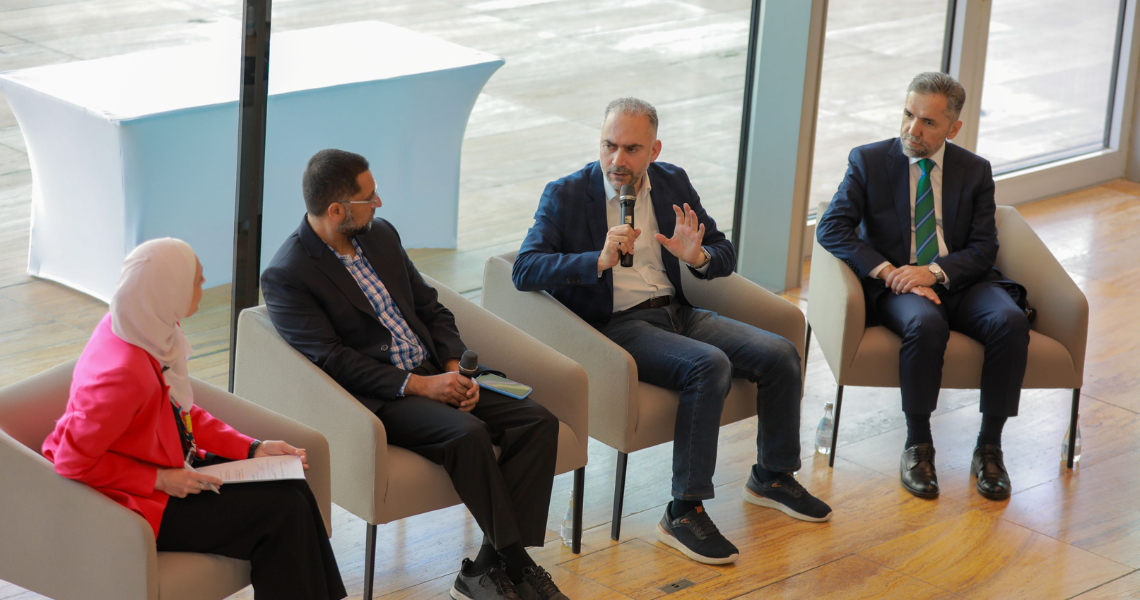
Qatar Foundation’s (QF’s) Earthna Center for a Sustainable Future (Earthna) and QF’s Hamad Bin Khalifa University’s (HBKU) College of Islamic Studies have officially launched their publication, Semiotics of Nature: Recharging Nature with Meaning for Environmental Ethics and Action, during a special event held on Monday, 16 February 2026, at the ThinkBay Auditorium in Education City.
Drawing from Islamic teachings, the book emphasizes that nature possesses intrinsic value beyond its economic use, and that humans are entrusted with its care as stewards (khalA< Dr. Gonzalo Castro de la Mata, Executive Director of Earthna, said: “At Earthna, we believe that achieving true sustainability requires more than policies, technologies, or metrics, it requires ethics and values. Semiotics of Nature reminds us that it is not merely a resource to be optimized, but a sacred system of signs that calls for ethical reflection, responsibility, and care. Grounded in Islamic principles such as tawhid, khilafah, and universal fraternity, this digital book aligns deeply with Earthna’s mission to integrate environmental, social, and economic dimensions of sustainability. By reconnecting scientific understanding with values and faith, it offers a holistic framework that supports the Qatar National Vision’s aspiration for human, social, economic, and environmental development, ensuring prosperity that is both enduring and morally grounded.” At the event, the author, Dr. Recep A?entürk, Dean of the College of Islamic Studies at HBKU, reflected on the book’s chapters and central ideas, highlighting the urgent need to restore ethical and moral perspectives in guiding humanity’s engagement with nature. Dr. Recep A?enturk commented: “Islamic shariah has high objectives such as protection of the human life. Yet protecting human life cannot be achieved without protecting nature. This view requires an understanding of the semiotics of nature to complement scientific study of nature. This book proposes practical strategies and mechanisms for new and yet rooted frameworks for environmental sustainability by changing the concept of nature into a sign and a book with a meaning communicated to us through a silent eloquence. The book calls for reviving the meaning of nature and our ethical relationship with it to promote awareness about our responsibility to serve as the stewards on earth.” A panel discussion followed, focusing on how Islamic values are already being translated into initiatives that promote nature protection, responsible consumption, and sustainable development. The panel featured Dr. Mutaz Al-Khatib, Associate Professor of Methodology and Ethics at the Research Center for Islamic Legislation and Ethics (CILE) at HBKU, and Dr. Osman Umarji, Director of Global Data Studies at the Yaqeen Institute for Islamic Research and Senior Consultant at QF. Panelists shared insights from their respective institutions and offered recommendations for future pathways to transform ethical principles into actionable knowledge and practice. Ruba Hinnawi, Technical Lead at Earthna, commented: “Earthna's collaboration with Dr. Reçep on The Semiotics of Nature book emerges from a clear intellectual and ethical gap: the limited accessible resources that revives the meaning of nature and creation in Islam and its intrinsic relationship to ethical development and social justice. Drawing on Qur’anic verses and the Prophet’s teachings, the book re-reads nature as a system of signs, A?yA?t, that invite reflection, responsibility, and moral action. It speaks to Muslim youth and elders alike, while remaining accessible to non-Muslim readers seeking an Islamic-rooted perspective on sustainability.” Dr. Osman Umarji noted: “The purpose of this book is to ground sustainability in Islamic principles and help change the status quo. When economic priorities conflict with environmental responsibility, society often chooses the economic path. This book challenges that reality by highlighting Islamic principles and encouraging a shift away from a profit-driven exploitation towards ethical responsibility in how we value and protect nature.” Dr. Mutaz Al-Khatib said: “Engagement with contemporary environmental debates must proceed on three levels: producing rigorous Islamic environmental scholarship; working within institutions for implementation; and presenting Islam as a universal religion that responds to global concerns. Islamic ethics is grounded in a triadic structure integrating intention, the form of the act, and its ultimate end. Accordingly, moral evaluation extends beyond isolated actions to encompass the systems, motivations, and ultimate purposes that shape environmental conduct.” The event brought together scholars, practitioners and institutional leaders for dialogue and knowledge exchange on sustainability from an Islamic perspective, reflecting Earthna’s ongoing commitment to integrated ethical, cultural and policy-oriented approaches. The session concluded with a book-signing, allowing attendees to engage directly with the author. Available in English and Arabic, Semiotics of Nature: Recharging Nature with Meaning for Environmental Ethics and Action adds to the ongoing discourse on the role of ethics and values in shaping sustainable futures. The book is accessible as a digital publication and as a printed edition.