


In the Gulf, time on the water has never been just about escape. It is about gathering, hosting and moving between moments — often within the same day. A morning dedicated to fishing, an afternoon of unhurried cruising and an evening anchored offshore with family and friends. It is a rhythm that is uniquely regional and increasingly, it is reshaping the kind of vessels discerning owners are choosing.
Where traditional yachting once leaned toward formality and separation of purpose, today’s buyer is seeking something far more intuitive: a boat that adapts effortlessly to how life in the GCC is actually lived.
It is within this shift that catamarans are quietly redefining the landscape.
A More Considered Way to Be on the Water
Leisure boating in the region has matured into something more nuanced than pure luxury or pure utility. Owners are no longer selecting vessels based solely on size or status, but on how seamlessly they support a lifestyle that moves between functionality and leisure.
The expectations are clear. A boat must feel as comfortable hosting a group as it does navigate open water. It must offer stability without sacrificing performance, and space without unnecessary excess. Above all, it must be effortless to use — not just admired from a distance.
This is where the catamaran distinguishes itself.
Space, Stability, and the Luxury of Ease
There is a quiet confidence in the way a catamaran occupies the water. Its wider stance delivers a sense of balance that is immediately noticeable, particularly when entertaining or fishing — two activities that define much of the region’s boating culture.
The experience is not dramatic, but it is decisive. Movement is steadier. Conversations are uninterrupted. Time onboard feels less managed and more natural.
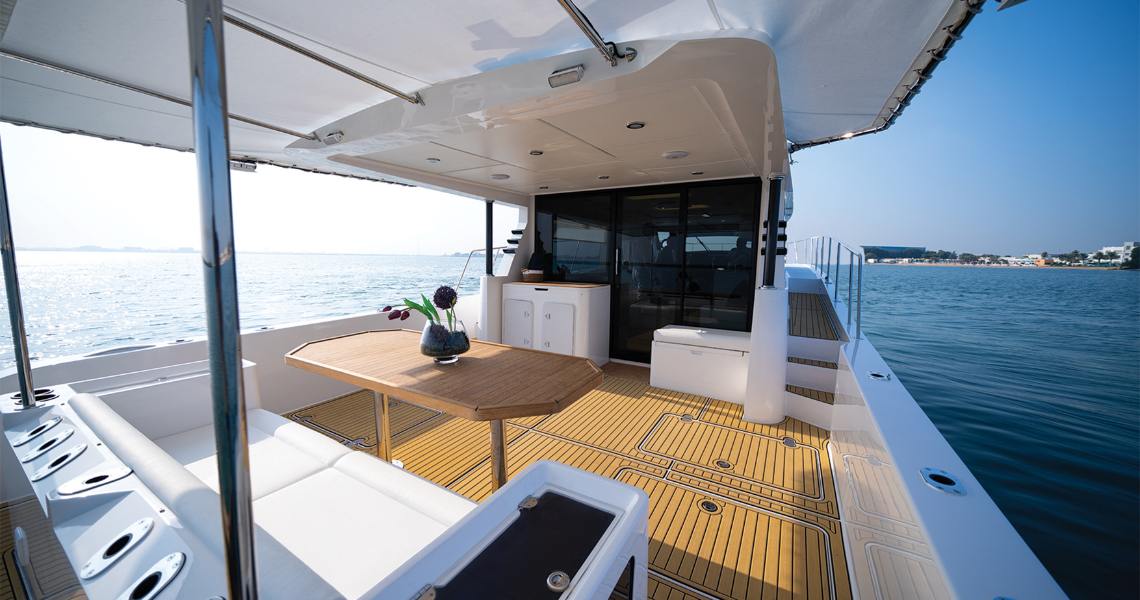
The additional beam also transforms how space is experienced. Rather than compartmentalised interiors, the layout opens up, allowing for fluid interaction — a quality that resonates deeply with the Gulf’s social fabric.
It is, in many ways, a different interpretation of luxury. One that prioritises comfort, presence, and usability over spectacle.
From Statement to Substance
For a new generation of buyers, the value of a vessel is increasingly measured by how it performs across real-life scenarios. The shift is subtle but significant: away from ownership as a statement, and toward ownership as an experience.
This is particularly evident in the growing demand for boats that can transition seamlessly between fishing and leisure — not as separate activities, but as part of a single, continuous day on the water.
Catamarans, by design, are uniquely suited to this duality. They offer the robustness required for serious fishing, alongside the openness and comfort expected for social cruising.
It is a balance that feels less engineered, and more inherent.
SilverCat: A Regional Expression of the Category
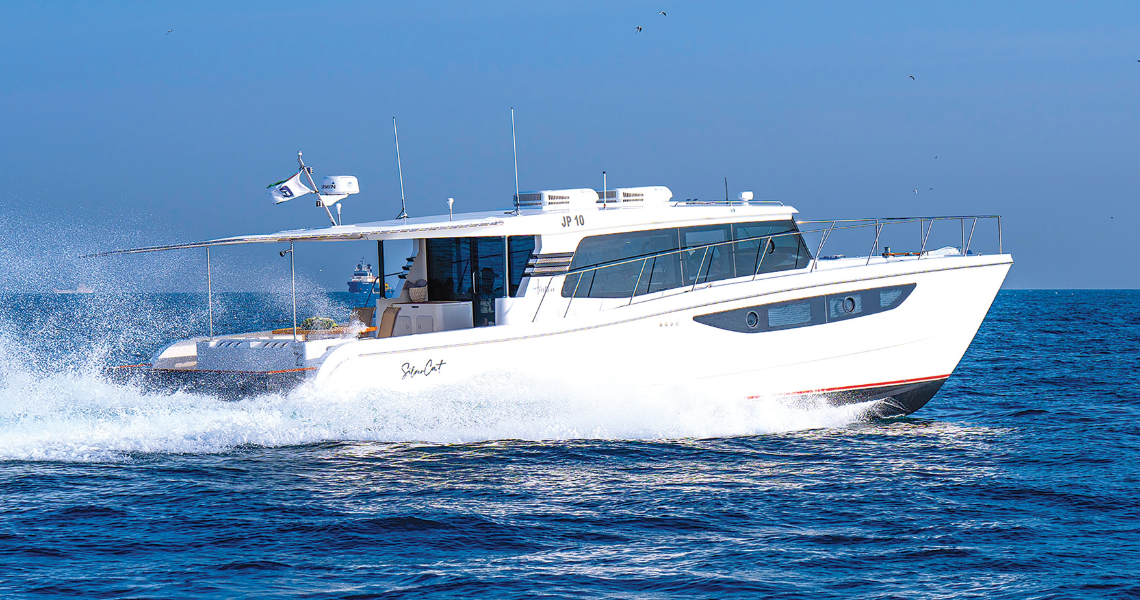
Within this evolving context, Gulf Craft’s SilverCat range presents a distinctly regional interpretation of the catamaran.
Rather than borrowing from global trends, it reflects an understanding of how the Gulf engages with the sea — where practicality and leisure are not opposing ideas, but complementary ones.
The design is deliberate in its restraint. Wide, open decks prioritise movement and interaction. Layouts are configured to support both activity and relaxation without compromise. There is a clarity to the experience onboard — one that feels intuitive rather than imposed.
It is not a vessel designed to impress in a marina. It is designed to perform, quietly and consistently, across the moments that define ownership.
The Direction of the Market
As boating culture in the GCC continues to evolve, the rise of catamarans suggests a broader recalibration of what luxury at sea represents.
It is no longer defined by scale alone, but by how intelligently a vessel integrates into the rhythms of daily life. By how easily it accommodates family, friends, and purpose — without requiring adjustment or effort.
In this sense, the appeal of the catamaran is not simply technical. It is philosophical.
It offers a way of being on the water that feels more aligned, more considered, and ultimately, more reflective of the region itself.
In the Gulf, where time is often best measured in moments shared, the most compelling vessels are no longer those that demand attention — but those that allow it to flow effortlessly.