


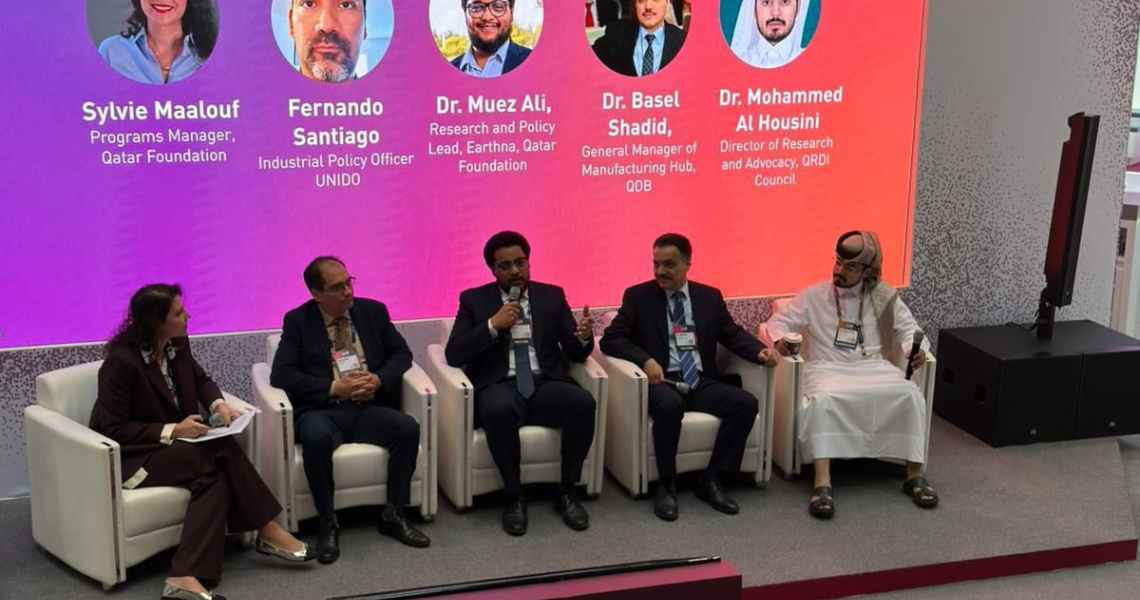
Earthna Center for a Sustainable Future (Earthna), a member of Qatar Foundation (QF), and the United Nations Industrial Development Organization (UNIDO) launched a new collaborative report, 'Industrial Policies for Economic Diversification in Qatar: A Research and Policy Agenda', during a session hosted at the Qatar Research, Development and Innovation (QRDI) Council Pavilion on 4 February at Web Summit Qatar, at the Doha Exhibition and Convention Center (DECC).
The report outlines a research and policy agenda to support Qatar’s economic diversification ambitions through industrial policy aligned with Qatar National Vision 2030, the Third National Development Strategy (NDS3), the Qatar National Environment and Climate Change Strategy, and the Qatar National Manufacturing Strategy 2024-2030. It emphasizes the role of industrial policy in advancing export diversification, productivity growth, innovation, and climate-compatible development, particularly as Qatar works toward its Nationally Determined Contribution target of a 25 percent reduction in emissions by 2030.
Dr. Gonzalo Castro de la Mata, Executive Director of Earthna, said: “Qatar’s Third National Development Strategy offers a strategic platform for targeted industrial policies that advance sustainable economic growth and diversification through priority growth clusters and enabling reforms. To be effective, industrial policy must be co-designed with stakeholders, selective, and institutionally robust. This report lays the groundwork for structured engagement to develop robust programs that build on global best practices to support Qatar’s economic diversification agenda.”
Gunther Beger, Managing Director of the Directorate for SDG Innovation and Economic Transformation, UNIDO, said: “Industrial policies can be the engine of a new era of prosperity, one that reconciles competitiveness with sustainability and inclusiveness. To achieve this, we need strong partnerships; governments, private sector leaders, and international organizations working together to mobilize investment, share knowledge, and scale innovation.
UNIDO stands ready to support governments and private sector partners in designing policies that enable industries, empower SMEs, and advance technologies for a climate-conscious, sustainable development future. Together, we can turn challenges into opportunities, amplify impact, and position the Gulf as a hub for sustainable industrialization.”
The report explores how Qatar can leverage industrial policy to build on an existing and evolving industrial base, new technologies and manufacturing strategies, and benefit from the income of its vast natural resources. The report also highlights Qatar’s strong vision for economic development as articulated in its National Development Strategies. Qatar’s unique position and financial independence mean it can reinvest its natural resources revenues into the green and blue economy to complement its diversification programs.
To enable this shift, the report recommends embedding industrial policy more firmly within NDS3 and increasing the evidence base to help identify priority sectors geared toward international markets and mechanisms for strengthening public-private partnerships. The report also recommends leveraging institutions such as the QRDI Council and the Qatar Development Bank to mobilise investment, scale innovation, and address the skills gaps needed to develop a diversified, export-oriented economy.